AI is here to stay regardless of whether there is a market bubble or not. Sure AI has grown rapidly and there will likely be a correction, but fundamentally AI is a tool that is increasingly proving useful. I do think organizations laying off people because of supposed AI gains are not really seeing that great of a gain. It also is short sighted if they are in a competitive market. Organizations should be looking to maintain the number of employees they have, but boosting their productivity with AI to take on more things from their backlogs that would help them move ahead of the competition.
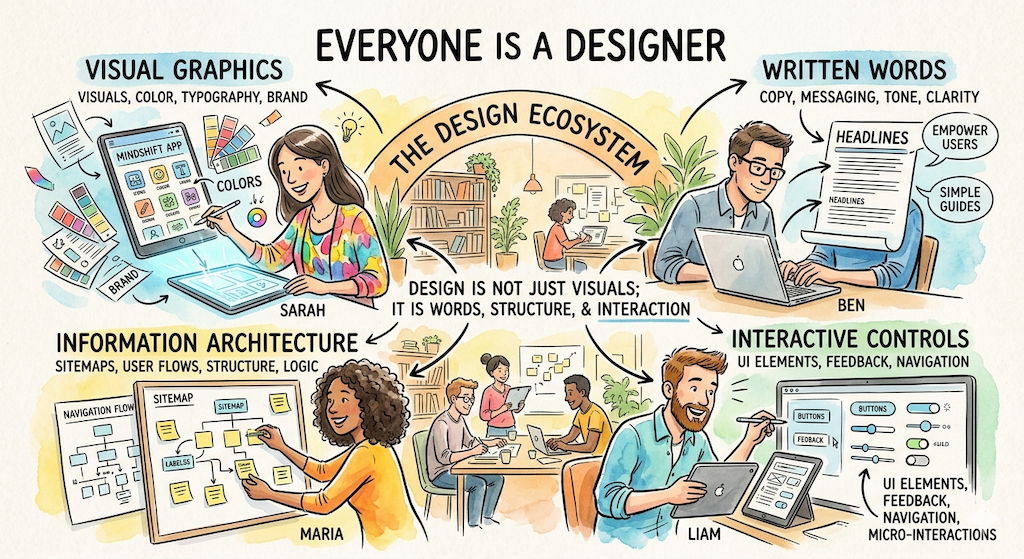
There has been a lot of discussion in the design community on what AI portends for our careers. Two years ago my view on AI was that it was still too immature to be useful in many design contexts. However, over the following two years we have seen huge strides in AI technology. Today AI is absolutely changing how designers work and widening the access for non-designers to design things as well. However, long before AI was changing design, Jared Spool was saying that everyone is a designer already[1].
Digital design tools have been opening the door for people to design without any background in design since the advent of desktop publishing in the late 1980s. So AI really is nothing new in this regard. What is changing is what gets called good design or rather good enough. A few design pundits are saying that designers will still be valued and needed for their “taste” [2]. I do not fully agree with this as “taste” does not automatically mean useful and it implies that it is something that cannot be taught.
First, what gets defined as good design encompasses much more than how something looks, which is what taste is most often used in reference to a design. As Steve Jobs famously said “Design is not just what it looks like and feels like, Design is how it works”[3] in reference to the design approach Apple used to create the iPod. There are plenty of examples of utilitarian design being great as they do what they are designed to do exceptionally well, but are otherwise not ornate or decorative.
Yes, some people have innate talent that makes it easier for them to create something considered beautiful, but again that is just one layer of what makes good functional design. And as it relates to learning what is a good functional design, this is certainly something that one can learn. When it comes to UX, the function is the foundation of the experience and how something looks can enhance or detract from that, but generally has limited effect on its utility (except in some possibly extreme cases).
The principles of good functional design are well understood and the practice of achieving good functional design is something that can be taught. Indeed, I expect in another couple years, if not sooner, AI will be able to give us good functional designs, because it can be fed the guidance needed for building things well. And it will likely also make them look good as it can also be fed styles and branding guidance. Believing that AI won’t ever be able to create beautiful and useful designs is short-sighted.
Where I feel we as designers and humans will still provide value is in the sentience required to identify and understand what are real problems and then the generation of ideas to solve those problems in new and innovative ways. Given that there is no real intelligence in AI this will be something that it cannot do… At least until there is another huge gain of computing power and AI truly becomes sentient. AI is very much a power tool that is growing in it’s capabilities, but it is still just a tool.
In that regard, I also do not believe the future of design is becoming prompt engineers. I expect AI to improve in its understanding and capacity to interpret requests and not require complicated set of .md files to be attached to every request. Alternatively, I expect AI prompts will be better configured to ask for those details and then remember them moving forward. Good designers will still need a design education to know how to communicate with AI and will still need to learn how to use analysis in understanding visual and knowledge problems to create useful and usable designs that solve those problems.
References
- Spool, Jared (Accessed: 2026-06-01) Design is a Team Sport. Center Centre. https://www.uie.com/designteam/
- Goodspeed, Elizabeth (Posted: 2024-02-29) Elizabeth Goodspeed on the importance of taste – and how to acquire it. It’s Nice That. https://www.itsnicethat.com/articles/elizabeth-goodspeed-column-taste-technology-art-280224
- Walker, Rob (Posted: 2003-11-03) The Guts of a New Machine, New York Times. https://www.nytimes.com/2003/11/30/magazine/the-guts-of-a-new-machine.html